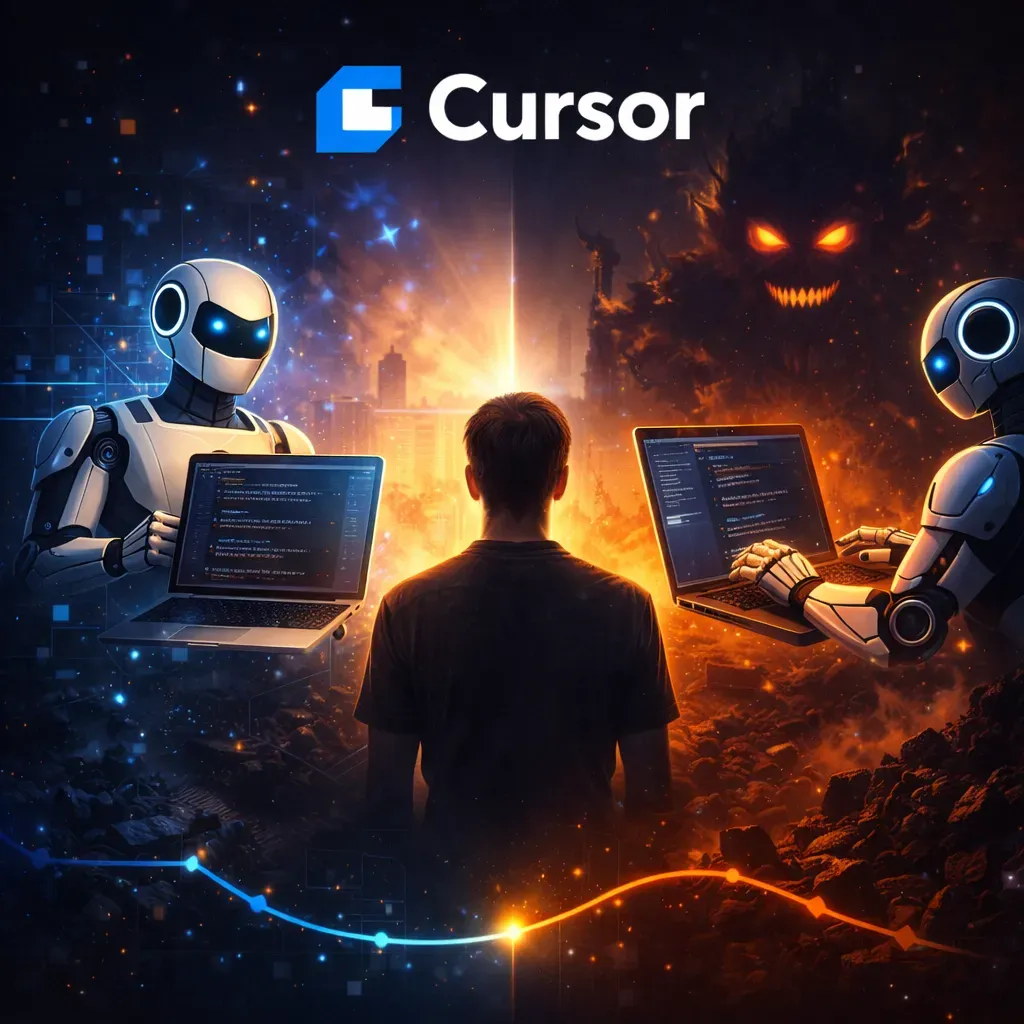
A Voice of Reason in the AI Coding Frenzy
As the AI coding assistant market heats up, Cursor CEO Michael Truell issued a rational warning in December 2025. The leader of this company valued at $29.3 billion with $1 billion in annual revenue is calling on developers to avoid the trap of “vibe coding.”
According to Fortune’s report, Truell defines “vibe coding” as “AI-assisted development where you close your eyes and don’t look at the code at all,” warning that this practice is “like building a house without knowing what’s going on under the floorboards.”
Market Scale and Current Usage
Rapid Growth in Adoption
The proliferation of AI coding tools is astonishing. Latest surveys show that Stack Overflow’s 2025 Developer Survey indicates 65% of developers currently use AI coding tools at least weekly.
Major Market Player Performance:
- Cursor: 1 million daily active users, 300 employees, $1 billion annual revenue
- GitHub Copilot + Claude Sonnet 4.5: Became the primary combination for many developers
- Google Gemini 3: Demonstrated powerful coding capabilities
- Amazon Kiro: Software coding agent capable of independently handling complex backlog tasks
Enterprise Adoption Reality
Both Microsoft CEO Satya Nadella and Google CEO Sundar Pichai claim that approximately one-quarter of their companies’ code is now AI-generated. This proportion has become standard configuration for tech giants by the end of 2025.
Controversies and Challenges
Questioning the Productivity Myth
Despite market optimism, MIT Technology Review reports that some frontline developers’ enthusiasm is waning. A growing body of research suggests the claimed productivity gains may be illusory.
Job Market Impact
A Stanford University study found that employment among software developers aged 22 to 25 fell nearly 20% between 2022 and 2025, coinciding with the rise of AI-powered coding tools.
Key Statistics:
- Young developer employment rate: ↓ 20% (2022-2025)
- AI tool usage rate: ↑ 65% (at least weekly)
- Major enterprise AI-generated code ratio: ~25%
Actual Progress in Technical Tools
Tool Ecosystem in December 2025
According to Shakudo’s analysis, the AI coding assistant market at the end of 2025 is characterized not by one model suddenly becoming the “best choice,” but by the tools around these models changing how developers actually work.
Mainstream Tool Combinations:
- Daily Development: GitHub Copilot + Claude Sonnet 4.5
- Asynchronous Collaboration: Google Jules (collaborative partner agent)
- Independent Task Handling: Amazon Kiro
- Security Checks: AWS Security Agent
- Performance Testing: AWS DevOps Agent
Google’s AI Research Breakthroughs
Google’s annual review shows that Gemini 3 launched in November 2025 and Gemini 3 Flash launched in December mark “the year AI began to really think, act and explore the world alongside us.”
Google Labs’ Jules, as an asynchronous coding agent, becomes a collaborative partner for developers rather than simply a code generation tool.
Cursor CEO’s Warning
The Danger of Building on Shaky Foundations
The core of Truell’s warning is that over-reliance on AI without understanding the underlying code leads to technical debt accumulation and increased system fragility.
“Vibe Coding” Risks:
- Unable to understand how code works
- Rapid technical debt accumulation
- Difficult system maintenance
- Security vulnerabilities hard to discover
- Lack of debugging capabilities
Recommendations for Proper AI Coding Tool Usage
Industry experts suggest healthy usage practices:
- Understand Generated Code: Review AI-produced content line by line
- Maintain Programming Fundamentals: Don’t abandon core skill learning
- Selective Use: Use AI for repetitive tasks, design complex logic manually
- Establish Review Mechanisms: Set up code review processes
- Continuous Learning: Keep up with underlying technology evolution
Market Outlook and Challenges
Continued Funding Frenzy
Despite controversies, market investment enthusiasm remains high. Cursor’s completion of $2.3 billion funding in 2025 with a subsequent valuation of $29.3 billion shows investor confidence in AI coding tools.
Technology Maturity Assessment
Developer community discussions indicate that AI coding tools at the end of 2025 have evolved from simple code completion to understanding project context and architectural design.
Current Technical Boundaries:
- ✅ Code completion and generation
- ✅ Bug fix suggestions
- ✅ Test case generation
- ✅ Automated documentation
- ⚠️ Complex system architecture design
- ⚠️ Performance optimization decisions
- ❌ Innovative algorithm invention
- ❌ Global business logic understanding
Real Impact on Developers
Skill Requirements Transformation
As AI tools become widespread, the skill sets developers need are changing:
Traditional Skills Remain Important:
- Algorithm and data structure understanding
- System design capabilities
- Debugging and problem-solving
- Code review abilities
New Essential Skills:
- AI tool prompt engineering
- Evaluation capabilities for AI-generated code
- Human-AI collaborative workflow design
- Best practices for AI-assisted development
Career Development Recommendations
Facing the era of AI coding assistants, developers should:
- Embrace Tools But Remain Critical: Use AI to improve efficiency but don’t blindly trust
- Deepen Core Capabilities: Thinking and design capabilities that AI cannot replace become more important
- Focus on Architecture Level: Transform from code implementer to system designer
- Continuous Learning and Updates: Track latest AI tool developments and best practices
Industry Observations and Future Trends
2026 Outlook
Based on predictions from multiple industry experts, the AI coding assistant market in 2026 will show the following trends:
Technical Evolution Directions:
- Stronger multi-file context understanding
- Project-level refactoring capabilities
- Better code quality assurance
- Deep integration with CI/CD
Market Competition Landscape:
- Coexistence of open source and commercial tools
- Emergence of vertical domain-specific tools
- Maturation of enterprise solutions
- Diversification of pricing models
Industry Standardization Process
As tools mature, the industry begins discussing standards and best practices for AI-assisted development, including:
- Code quality assessment standards
- Review processes for AI-generated code
- Security check mechanisms
- Licensing and copyright issue handling
Conclusion
The Cursor CEO’s warning reminds the entire industry that AI coding assistants are powerful productivity tools but not a panacea. At the end of 2025, when 65% of developers use AI tools and young engineer employment rates have fallen 20%, we need to view this technology more rationally.
The correct positioning of AI coding assistants should be “tools that enhance human capabilities,” not “shortcuts that replace human thinking.” Developers must find a balance between improving efficiency and maintaining core capabilities, while enterprises need to establish appropriate usage guidelines and quality assurance mechanisms.
As Cursor, GitHub Copilot, Google Gemini, and Amazon Kiro continue to evolve, 2026 will be a critical year for AI-assisted development to truly mature. But as Truell said, the real value lies in understanding what you’re building, not just having AI quickly produce code.
References:
