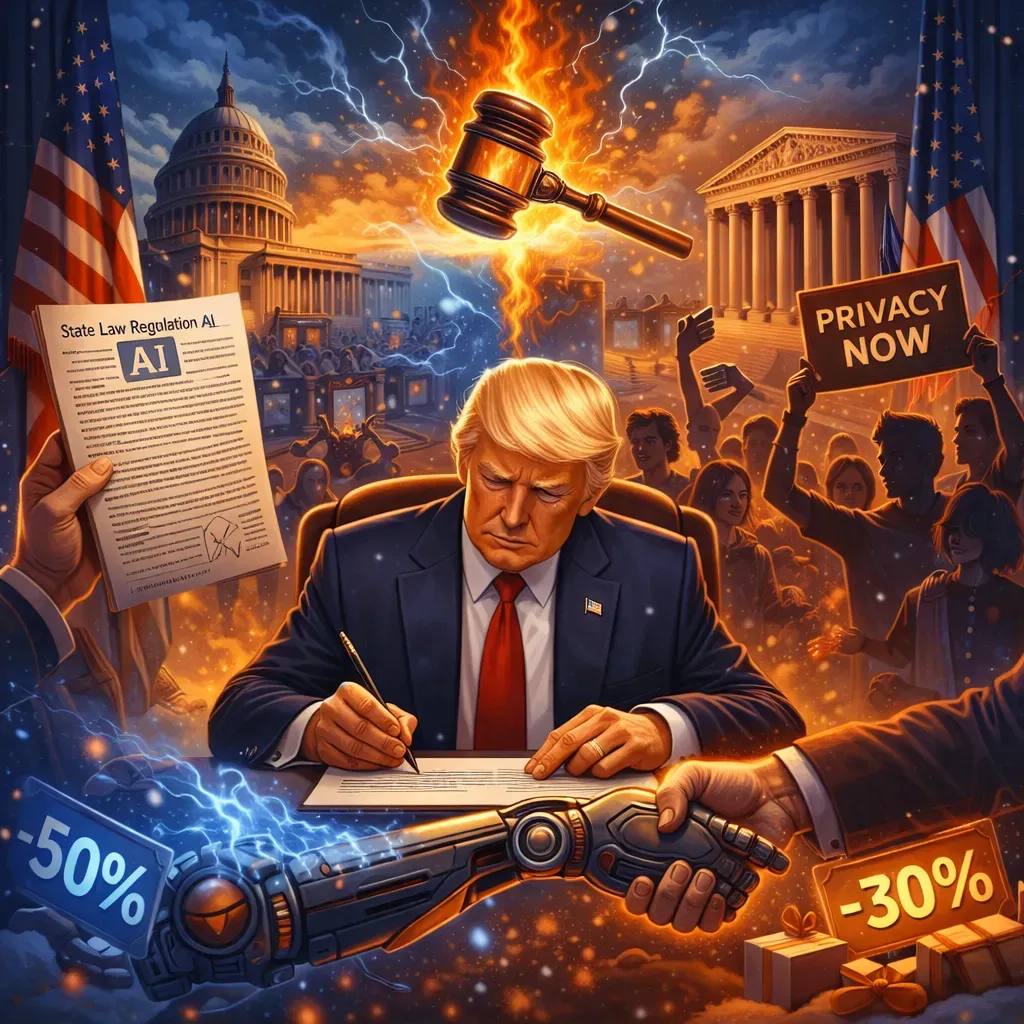
December 2025, US President Trump signed a highly controversial executive order establishing a national artificial intelligence policy framework and directing the federal government to proactively challenge AI regulatory laws enacted by individual states. This executive order, titled “Ensuring a National Policy Framework for Artificial Intelligence,” commands the Attorney General to establish an AI Litigation Task Force specifically to identify and sue state AI laws deemed unconstitutional, preempted by federal law, or otherwise unlawful and hindering innovation. The White House emphasized in its statement that the current regulatory environment with 50 states independently creating rules makes corporate compliance difficult, and accused some state laws of requiring AI models to embed ideological bias, violating the First Amendment. The tech industry broadly supports this move, believing unified federal regulation benefits innovation; however, privacy rights advocacy groups and some state government officials strongly oppose it, viewing this as federal government overreach infringing on states’ rights and weakening consumer and worker protections. This federal versus states’ rights battle marks a critical new phase in American AI governance.
Executive Order Core Content
National AI Policy Framework Objectives
Executive Order Key Provisions
“Ensuring a National Policy Framework for Artificial Intelligence” executive order highlights:
-
Federal Priority Principle:
- Establishes federal government leadership in AI regulation
- Prevents state and local governments from enacting inconsistent rules
- Unifies national AI industry development standards
-
AI Litigation Task Force Establishment:
- Under Department of Justice
- Mission: Identify, evaluate, and challenge problematic state AI laws
- Authority: File federal lawsuits to overturn state laws
-
State Law Review Standards:
- Unconstitutional Standard: Violates First Amendment (free speech)
- Preemption Standard: Conflicts with or contradicts federal AI policy
- Innovation Obstruction Standard: Creates unreasonable barriers to AI innovation
-
Ideological Neutrality Requirement:
- Prohibits state laws requiring AI models to output specific ideological content
- Prohibits mandating AI adopt “fairness” or “bias elimination” mechanisms (if deemed ideological requirements)
White House Official Rationale
Why Federal Unified Regulation Needed?
White House arguments in executive order accompanying statement:
Problem One: Regulatory Fragmentation
50 different state rules creating difficulties:
- Compliance Complexity: Businesses must comply with 50 different regulatory systems
- Cost Explosion: Each state requires independent compliance processes and legal consultation
- Product Development Difficulty: AI models may need state-by-state adjustments
- Small Business Disadvantage: Startups cannot afford multi-state compliance costs
White House examples:
- California AI Transparency Act requires training data disclosure
- New York AI Employment Law regulates hiring algorithms
- Texas AI Content Labeling Law requires marking AI-generated content
- Illinois AI Biometric Law restricts facial recognition
Companies operating nationwide must simultaneously comply with all these laws, with each state having different enforcement standards, penalties, and exemption clauses.
Problem Two: Ideological Embedding
White House accusations against some state laws:
- California AB 2013: Requires AI systems adopt specific “fairness” definitions on gender, race issues
- New York Hiring AI Law: Mandates algorithms achieve specific minority hiring ratios
- Washington Proposal: Requires AI assistants adopt specific positions on climate change
White House argues:
- These requirements equal compelled speech
- Violate First Amendment protected free speech
- Government shouldn’t force private entities to express specific viewpoints
Problem Three: Innovation Obstruction
Over-regulation’s impact on industry development:
- Market Entry Barriers: AI startups struggle to enter multi-state markets
- R&D Resource Dispersion: Compliance consumes resources meant for innovation
- Talent Drain: Overly strict regulations may drive AI companies and talent overseas
- International Competitiveness Decline: China, EU accelerating AI development, US may fall behind
White House data citations:
- 2024 US AI startup funding down 18% from 2023
- 27% surveyed AI companies cite state regulation as biggest operational challenge
- Projected 12-15 states passing new AI regulatory laws by 2026
AI Litigation Task Force Responsibilities
Task Force Organizational Structure
DOJ AI Litigation Task Force setup:
- Leadership: Attorney General direct oversight
- Staffing: Expected 20-30 federal prosecutors and attorneys
- Budget: FY2026 initial budget approximately $15-20 million
- Collaborating Units: Federal Trade Commission (FTC), Commerce Department, White House Office of Science and Technology Policy
Workflow
How task force challenges state laws:
-
Monitoring Phase:
- Track state AI-related legislative dynamics
- Collect industry feedback on state laws
- Analyze state law conflicts with federal policy
-
Evaluation Phase:
- Legal analysis: Determine if state laws unconstitutional or preempted
- Impact assessment: Analyze state law effects on innovation and competition
- Prioritization: Decide which state laws to challenge first
-
Action Phase:
- Communicate with state governments, attempt negotiated amendments
- If negotiation fails, file federal court lawsuits
- Seek injunctions suspending state law enforcement
-
Litigation Strategy:
- Assert Federal Preemption
- Assert state law violates Commerce Clause
- Assert state law violates First Amendment
Tech Industry Reaction
Support Camp Views
Silicon Valley Tech Giants
Major tech company positions:
Meta (Facebook)
Spokesperson statement:
- “Welcome federal government establishing unified framework, fragmented regulation is AI development’s biggest obstacle”
- “We support reasonable regulation, but need nationwide consistency”
- Meta faces multiple AI-related lawsuits in California and New York, deeply affected by state laws
Chief Legal Officer statement:
- “50 different AI legal standards make compliance a nightmare”
- “Recommend Congress pass comprehensive federal AI legislation, replacing state patchwork”
- Google DeepMind already relocated some R&D to states with looser regulations
OpenAI
CEO Sam Altman tweet:
- “AI is global technology, needs national or even international regulatory framework”
- “State-level regulation will disadvantage US in AI race”
- OpenAI already invested heavily in lobbying federal AI legislation
Microsoft
President Brad Smith statement:
- “Support federal unified standards, but should include strong consumer and privacy protections”
- “Shouldn’t completely ignore risks in name of innovation”
- Microsoft position relatively moderate, emphasizing balance between innovation and protection
Opposition Camp Views
State Government Officials
California Governor Gavin Newsom
Public statement:
- “Trump administration again attempting to strip states’ power to protect residents”
- “California AI laws are necessary measures in absence of federal action”
- “We will defend states’ rights in court”
- California already allocated $10 million preparing for legal battle
New York Attorney General Letitia James
Statement:
- “Federal government shouldn’t sacrifice consumer protection for tech giant interests”
- “New York will join other states resisting this unconstitutional overreach”
- Plans to organize cross-state coalition
Privacy and Civil Rights Organizations
American Civil Liberties Union (ACLU)
Policy Director statement:
- “This is direct attack on states’ ability to protect civil rights”
- “Federal government lacks adequate AI regulation, states filling gap is correct”
- “Trump administration prioritizing corporate profits over people’s rights”
Electronic Frontier Foundation (EFF)
Statement:
- “State AI laws, while imperfect, provide important protections”
- “Federal preemption should establish stronger protections, not eliminate protection”
- “Concerned this creates regulatory vacuum”
Federal vs State Rights Legal Dispute
Constitutional Preemption Doctrine
Federal Preemption Theory Basis
US Constitution Supremacy Clause:
- Constitutional Basis: Article VI, Clause 2
- Principle: Federal law superior to state law
- Application: When federal and state laws conflict, federal law prevails
Three Preemption Types
-
Express Preemption:
- Congress explicitly declares in law that states lack authority to legislate
- Example: Federal aviation law expressly excludes state aviation regulation
-
Implied Preemption:
- Field Preemption: Federal regulation so comprehensive, no room for state intervention
- Conflict Preemption: Complying with state law would frustrate federal law objectives
-
Actual Conflict:
- Impossible to simultaneously comply with federal and state law
- State law obstructs federal policy goal achievement
Does Federal Preemption Exist for AI Regulation?
Controversy points:
Trump Administration Claims:
- Federal government already established AI policy framework through multiple executive orders
- Commerce Department, FTC and other federal agencies have AI regulatory authority
- State laws conflict with federal “light regulation, promote innovation” policy goals
State Government Rebuttals:
- Congress never passed comprehensive AI legislation, no express preemption
- Federal AI policy mostly guidelines and voluntary frameworks, not mandatory law
- States have traditional police power protecting resident health, safety, welfare
- AI regulation involves consumer protection, labor rights, privacy - traditional state jurisdiction areas
First Amendment Controversy
Free Speech vs AI Regulation
Trump administration core argument:
Compelled Speech Theory
Argues state AI laws violate First Amendment:
-
Algorithm as Speech:
- AI model outputs are speech protected by First Amendment
- Government cannot force private entities to express specific viewpoints
-
Ideological Neutrality Principle:
- Government cannot require AI adopt specific “fairness” or “bias” definitions
- Example: California law requiring AI adopt specific standards on gender issues equals forced specific ideology
-
Precedent Citations:
- Hurley v. Irish-American Gay Group (1995): Government cannot force private expression of messages they don’t endorse
- Janus v. AFSCME (2018): Compelled speech unconstitutional
State Government Rebuttals
AI regulation doesn’t violate First Amendment:
-
Commercial Speech Exception:
- AI mostly used for commercial purposes, commercial speech protection level lower
- Government can reasonably regulate commercial speech
-
Non-Speech Conduct:
- AI regulation targets discriminatory conduct, not speech content
- Example: Prohibiting hiring AI discriminating against women equals prohibiting employer discrimination, unrelated to speech
-
Constitutional Information Disclosure:
- Requiring disclosure of AI usage, training data sources are reasonable information disclosure
- Precedent: Nutrition labels, drug warnings are constitutional mandatory disclosures
International Comparison and Impact
EU AI Act Comparison
EU Unified Regulatory Model
EU AI Act (effective 2024):
Characteristics:
- Unified Law: Applies to all 27 member states
- Risk Classification: Categorizes AI systems as unacceptable, high-risk, limited risk, minimal risk
- Strict Requirements: High-risk AI must meet safety, transparency, accountability standards
- Massive Fines: Up to 7% of global revenue
Member State Role:
- Each country establishes AI regulatory agency
- Enforces EU law but cannot enact contradictory laws
- Can establish detailed rules within EU legal framework
Effect:
- Avoids fragmentation across 27 countries
- Businesses face single compliance standard
- Criticized as overly strict, potentially hindering innovation
China Centralized Regulatory Model
Central Government Leadership
China AI regulation characteristics:
System:
- Cyberspace Administration, MIIT, Ministry of Science and Technology lead centrally
- Provincial governments enforce but lack independent legislative authority
- Unified regulatory standards and review processes
Key Regulations:
- Interim Measures for Generative AI Service Management (2023)
- Algorithm Recommendation Management Regulations (2022)
- Requires AI service registration filing, content review
Features:
- Emphasizes “socialist core values”
- Strict political content review
- Data localization requirements
Conclusion
President Trump’s signed AI national policy framework executive order marks a critical turning point in American artificial intelligence governance. By establishing an AI Litigation Task Force proactively challenging state AI laws, the federal government attempts to establish a unified national regulatory framework, ending the current fragmented situation of 50 states independently regulating. The White House argues unified regulation benefits innovation, reduces compliance costs, and enhances US AI competitiveness; but critics believe this sacrifices consumer protection for tech giant interests and constitutes unconstitutional infringement on states’ rights.
Key Controversy Points:
- Federal Preemption: Is federal AI policy sufficient to preempt state laws? Can executive orders substitute without explicit Congressional legislation?
- First Amendment: Does AI regulation infringe free speech? Are algorithm outputs constitutionally protected?
- States’ Rights vs Federal Power: Does the state have authority to protect residents in this emerging AI field?
- Innovation vs Protection: How to balance promoting AI innovation with protecting consumers, workers, and privacy?
Future Developments:
This federal versus state legal battle may continue for years, potentially appealing to the Supreme Court. During this period, the AI industry will face legal uncertainty, state governments will mobilize resources defending legislative authority, and civil society organizations will engage in fierce courtroom and public opinion battles. Regardless of outcome, this controversy will profoundly impact American and global AI governance models.
This isn’t merely a legal technical issue, but a fundamental question concerning democratic governance, power balance, and technology development direction. 2026 will be a decisive year for American AI governance, worthy of everyone’s continued attention.
Sources:
